
AI can answer pretty much any question you throw at it. It can go deep or broad, paint vivid analogies, or get microscopically specific, all depending on how you ask it to elaborate. It makes learning feel almost effortlessly low-barrier.
But wait... is it?
As I spent more and more time learning with AI, I hit a frustrating realization: I was constantly confusing "reading an answer" with "actually understanding it."
Don't get me wrong. Reading is a starting point, but understanding is a completely different process. True understanding is where structured thought is formulated through active synthesis.
For me, the learning spark usually ignites after several iterations of follow-up questions and answers. In the zone, this back-and-forth process is energetic and exciting—a true flow state of deep learning.
Yet, it is incredibly fragile.
The "Pebble in My Shoe" of AI Chat Interfaces
A standard chat interface is just like chatting with a friend. You talk about one topic, and then you naturally drift into another. It could be a closely related branch, or a totally unrelated tangent.
After 30 minutes of energetic chatting, you vaguely remember what was said, but none of it is organized in your memory. That's exactly how I used to feel after discussing a complex topic with AI. The information provided by the AI was incredibly useful, but it lacked a structured understanding flow.
In order to keep my discussions organized, I tried opening a separate chat session every time I noticed a new subtopic that might hijack my current focus. However, deciding on the right level of granularity was exhausting. If I made the topics too small, I ended up with an overwhelming list of chat sessions. If I kept them too broad, the separated sessions still ended up tangled with mixed topics.
It wasn't a hard blocker, but it felt like a constant pebble in my shoe.
I realized what I actually wanted: I imagined learning with a knowledgeable AI where my understanding map grows as we chat. I wanted to go as deep as I can across multiple chat sessions, across different AIs, and completely forget about chat session management. I wanted my understanding map to grow as I chat.
When I research a topic now, I create a root hashtag for it in Linkiige.
Case Study: Mapping the Bullish HBM Sector
For example, recently I've been researching HBM (High Bandwidth Memory)—a very bullish sector of US stocks.
I didn't know anything about it at first, so the very first hashtag I created was #HBM. Then I asked the AI: "What is HBM?"
In the very first response, I read several terms related to HBM that I wasn't familiar with at all—like GPU, TPU, and CUDA. But that didn't bother me or break my reading flow. Instead of derailing my current chat, I simply created corresponding downstream hashtags right inside the chat panel on the fly to circle back to later.
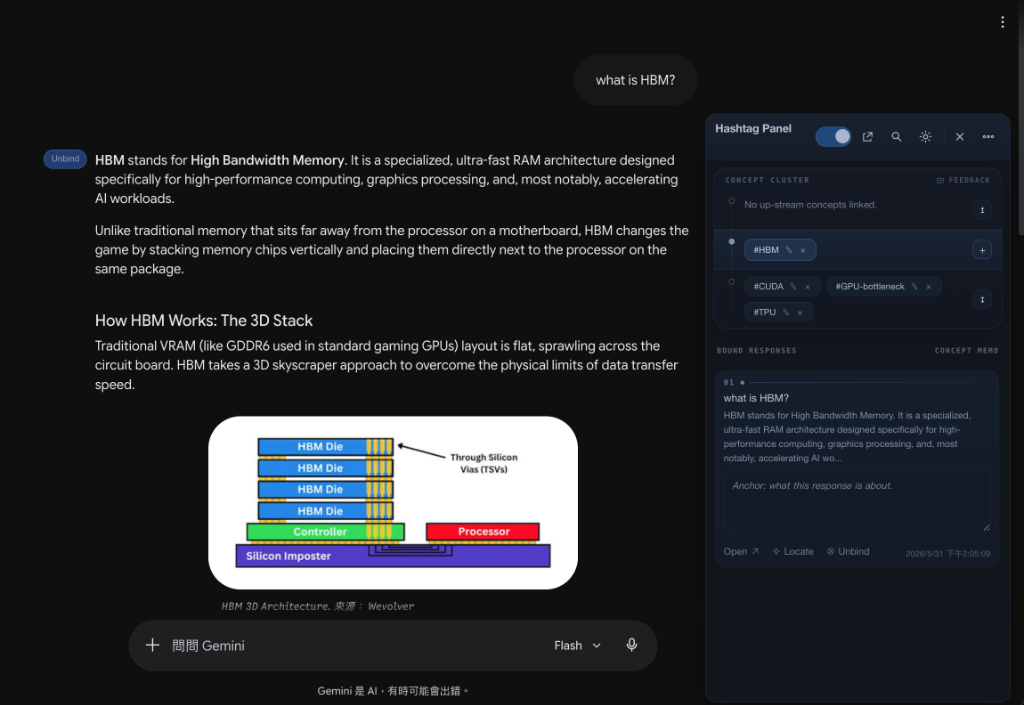
At this stage, I establish a "table of contents" for HBM in my knowledge map structure. It gives me a holistic view of the HBM knowledge space before I get bogged down in details.
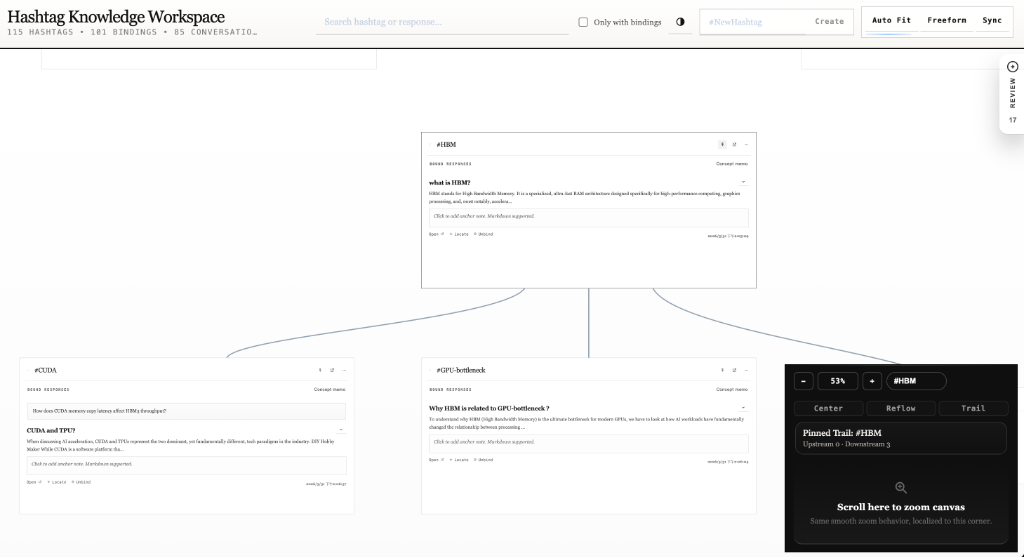
Diving Deep Without Anxiety
The next stage is to deep dive into each downstream topic (or upstream, depending on your learning habits). The hashtag graph continues to grow organically as I discuss related topics with the AI.
I don't worry about moving on to the next topic even if I don't fully understand the current one yet. Because it is already saved as a hashtag in my map, I know I can circle back anytime I want. I jump around topics very quickly, and soon the relations among them are built.
I pay far less attention to chat management now. I know exactly what I know and don't know just by looking at my knowledge map. When I encounter a new term like #CUDA, I also create a Concept Memo to note down active follow-up questions alongside the hashtag.
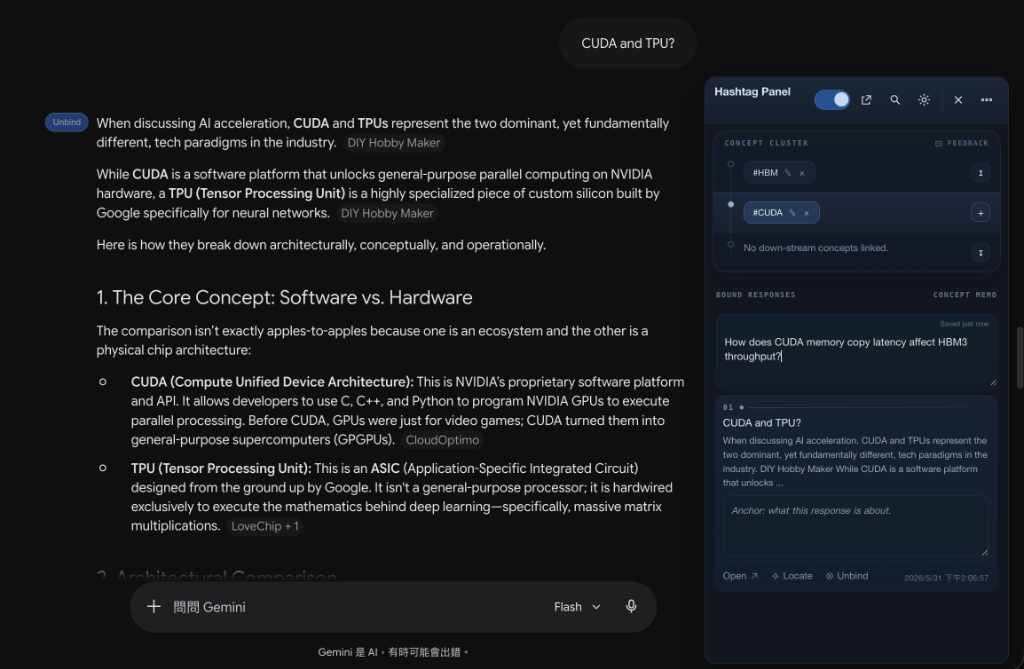
#CUDA concept memo, I jot down active follow-up questions to circle back to, ensuring no curiosity is lost when I switch contexts.
Usually, I can build a dozen hashtags in a few days. I might not be fully familiar with most of the corresponding topics yet. But that is completely fine.
I believe the first step of learning any massive topic is to grasp a holistic view of it, and then systematically tackle each piece. It's about building your own custom table of contents for that topic.
That table of contents is understanding. It's not about memorizing every detail immediately; it's about owning the structure of the topic itself.